Showing posts with label Hi5. Show all posts

Saturday, July 18, 2009

Why social networking fail?

Many social networking sites have come and gone, though it's easy to forget about most of them with monsters like Youtube and Facebook acting like they are the only kids in the classroom. Some have gone on to make their inventors of the year, but others have fallen into the gutter of floppery. Subsequent entries will focus on why they succeed and what opportunities they create.

1. Privacy concerns
The first reason I would highlight, and part of the reason why social networks have not really gained much traction outside of a self-selected group of people is the amount of privacy concerns that exist within certain age groups. Younger people are generally more immune to those but older people tend to worry about what the social networks in question do with their data and are worried that they will either be data mined or that they will suffer from identity theft. This anxiety has largely been driven by media emphasis on how your data on the Internet is unsafe and how there are “nefarious characters” running around the net.

2. No real reward or penalty system
Most social networks are putting a heavy emphasis on how many connection a user have. A user’s worth is based on his/her number of connection, not on the quality of those connections. This tends to drive a lot of people to try to connect to as many people as they can. Mary Hodder likens this effort to collecting baseball cards, an apt metaphor since the number of connections you have is no guarantee of the value of those connections.
However, few of the social networking sites are doing anything to gate the amount of connection. One of the nice thing on asmallworld is that it actually penalizes people for sending out invitations that were declined. I believe this is a good thing as it makes people rethink whether they want to attempt a connection or not.
The other question is the reward in social networking: what do I get for sharing my contacts? We know what the companies get but it’s sometimes fuzzier to see what extra value one gets from a social network. Some have done a good job at showing a sense of mission, whether it is job-related and expertise-related connectivity like connections LinkedIn or dating like… well, this is where it gets trickier.

3. Not granular enough
Context is generally missing from most social networks. For example, I may know Bob in a social context as a friend but I have no idea of how good an employee he is. Or I may know Joe in a work context but not realize that he’s not dating material for my friends. The lack of granularity as to the types of relationships is another current failure of most social networking sites.
The other thing that is missing from social network is a more fine-tuned approach to ranking relationships. Relationships are not binary. It’s not either someone is my friend or not. The truth of the matter is that relationships are very granular in nature: I may be a close friend to John, whom I’ve known for 20 years and hang out with on a daily basis and I may have been a friend with Peter in the past but haven’t seem him in 10 years. Yet, to a social network, if I added both of them as friends, we have the same types of relationships.
Similarly, there seems to be a trigger missing for evolving relationships: what if my relationship with Peter has been slowly degrading over time. Do I kick him out as a friend (an option few networks allow) or do I keep him on my list. This granularity is missing and it is odd that it doesn’t exist as it would be relatively easy to capture this data.
Situational relevance is another factor that is largely ignored by social networks today: in what context does that network function. It’s something that needs to be more granularly defined than the catch-all approach of existing implementations.

4. Not integrated with other apps
Should social networks be standalone apps or is social networking just a feature? There is really little value in knowing people just for the sake of knowing people. However, there is value in interfacing with those people, whether it is to find a job, get some information from a subject matter expert, find money, or get a new date.
I believe the real value of social network sites to the end user will eventually be discovered when they start integrating with other components like email and IM. Presence (is the person online or not), location services (where in the physical world is the person right now) and communication (can I phone/IM/email/page them now) would add greatly to the value of social networks.
However, at the current time, few efforts have been made to integrate the social networks with other apps. Which brings me to the biggest reason why social networks fail.

5. Walled Gardens
Social networking sites are walled gardens. They do not want to share information with others for fear that it will dilute their power as THE central hub for all relationships. This lack of interoperability is the primary problem with social networking sites and, I believe, one of the reason why their growth is impeded. A network that would be willing to open up could see better integration with other tools and could benefit from other sites connecting to it and creating more specialized sub-networks. For example, a large social networking site could become a large repository of a number of relationships with smaller sites looking at it to specialize across horizontal uses (for example, creating a site focused on dating or job search) or vertical ones (for example, a site focused on information exchange between subject matter experts within one particular domain).

Example of failed social networking site: Wal-Mart

This was Wal-Mart's failed attempt at a social networking site for teens. It was only online for ten weeks, with a preview left online for about two months after that. In many ways it was a MySpace clone where users could build profiles with graphics and text related to Wal-Mart products.
Why It Failed: To register for The Hub, user information was sent to parents in order to get approval. This attempt from Wal-Mart to avoid future lawsuits turned off many teens. There were also many obviously fake profiles on the site, from teens like "Beth" who just loved shopping at Wal-Mart in order to catch the eye of the cute guy at school. The myriad of advertisements for products cluttered the profiles and 90210-ish older models posed for the pictures of the fake teens.
What Can Be Learned From It: A successful social network needs to provide freedom for its users and as few in-your-face advertisements as possible.


Sources:
http://www.tnl.net/blog/2006/06/15/5-reasons-why-social-networks-fail/
http://www.bivingsreport.com/2008/a-look-at-failed-social-networks/

Sunday, July 12, 2009

How does "Web2.0" helps in social networking?

According to Wikipedia’s definition, Web 2.0, a phrase coined by O’Reilly Media in 2004, refers to a perceived second generation of web-based services—such as social networking sites, wikis, communication tools, and folksonomies—that emphasize online collaboration and sharing among users.”

The key aspects of Web 2.0 sites are:
a). Rich and interactive user interfaces.
b
). Involving others for active participation through social networking.
c
). Improved and continuous upgradation of software of data at a very quick pace.
d
). Modifications and remixes by other users to the content to add more value and consequently encouraging data consumption.
e
). It’s a global platform linked with Social Media to generate traffic via Social Networking and Social Media’s.

Web2.0 is all about Social networking of Social Media, or to be more precise, it’s all about connecting to each other through Social Media sites. Social Media includes Social Photo Sharing (flickr, picasa, photobucket, etc.), Social Networks (MySpace, Facebook, etc), Social Bookmarking (del.icio.us, diigo, furl) . This is a very important section where we build up networks all round the Global. Sites like MySpace, Facebook, Live Journal, TagWorld, Disney XD, Toyota Prius, MSN Groups, Yahoo 360. The term itself describes its features as this section of Social Media explains the sole method of creating and building social relationship out of nodes and ties. Well its pretty obvious how these social networking sites helps in tie-in up of different social network, all round. (MySpace, Facebook, etc),

If you are an online marketer, then the Web2.0 formulae will be much clearer to you than a normal person. When your website visitors will participate and submit content (text, images, pictures, videos), links, participate to discuss and comment, build network around as a end user (both you and your site visitors), then it will enormously help you to generate more online traffic and this whole process will be services and applications of Web2.0. For example, Web2.0 helps to encourage and motivate people, via Social Networking, to make quality contributions to the content on offer. This would not only make proper justification to the same but also add value to it. So it is very important to encourage and motivate others to participate and contribute so that it continually improves the whole service for all of us.


All in all, web2.0 can be advantageous in social networking by its features like interactive users interface, applications, motivation of participations, data consumption encourage, and somethings like that.

Source:
http://blogs.profitimo.com/2007/04/03/web20-all-about-social-networking/


Tuesday, June 23, 2009

Survey on Commercial Social Networking

Between February 20 and April 15, 2009, 980 nonprofit professionals responded to a survey abouttheir organization’s use of online social networks. The survey is sponsored by NTEN, CommonKnowledge and ThePort. Particpants were posed to survey about their use of commercial social networks such as Facebook, MySpace,LinkedIn, and others.


Survey Results
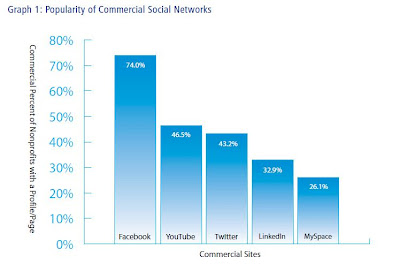
Commercial Social NetworksPopularity of Commercial Social NetworksBy a large margin, Facebook is the most popular of the commercial social networks with 74.0% of respondentsindicating that their organization has a presence there. YouTube and Twitter are a distantsecond and third with 46.5% and 43.2%, respectively, of nonprofit survey respondents indicating theymaintain a presence in these channels. Linked In was fourth with 32.9% , and MySpace fifth with26.1% of respondents.


Within individual vertical segments, professional associations were more likely to use LinkedInthan Facebook for their commercial social network efforts—51.7% of associations cited LinkedInas their commercial social network platform versus 32.8% of survey respondents across allverticals. Likewise, just 55.2% of associations reported using Facebook versus an average of74.1% across all verticals.

Staff Time and External Resources Dedicated to Commercial Social NetworksFully four-fifths (80.8%) of survey respondents committed at least one-quarter of a full-time staffmember to maintaining—marketing, managing and cultivating—their commercial social networkpresence over the last 12 months. Roughly two thirds (64.5%) of survey respondents dedicated onequarterto one-half of a full-time resource, and 16.3% committed three-quarters or more staff to theircommercial social networks.

Looking ahead, over half (55.0%) of survey respondents indicate they will increase staffing over thenext 12 months, 39.5%) say staffing will stay the same, and just 1 in 20 (5.6%) will decrease staffing.

Four out of ten (40.6%) survey respondents had some budget over the last 12 months for externalresources dedicated to helping with their commercial social network work, but just 8.3% set aside$10,000 or more, with only 1.4% allotting more than $100,000 to external resources to help withcommercial social network efforts.

About one-quarter (24.1%) of survey respondents indicate they will increase funding for external resourcesdedicated to helping with commercial social network efforts in the coming 12 months, whilethe majority (68.0%) say they will keep external resourcing budgets the same. 7.9% of survey respondentswill decrease their social network external resource budgets for the coming year.

From the survey, we learned that commercial social networks, especially Facebook, are popular, but average community sizes remain small, and presence is relatively short. Responding nonprofits are allocating small but real resources, staff and budget to their social networks. Survey respondents prefer traditional marketing channels to promote their social networks but are experimenting with new social media channels. For now, there is very little real revenue generated on these communities via fundraising and advertising. A minority of nonprofit survey respondents, about one third, have built and manage their own house social networks, using software from a wide variety of social network software vendors, with no clear leader among these vendors. The members of house social networks are as yet, with just a few exceptions, still relatively small as well.

Source: http://www.nonprofitsocialnetworksurvey.com/

Sunday, June 21, 2009

What Social Network Is the Right One for You?

The first question you must ask yourself in order to pick out the right social network is: What do you want out of a social network? Are you looking into social networks for business reasons? If so, a large general interest social network like MySpace or Facebook would be a good advertising face, while a business-oriented social network like Linkedin would be best for making good contacts.

Perhaps you are passionate about music. Last.fm combines the idea of a personalized radio station with social networking allowing you to create your own playlist, suggests music based on your preferences, and allows you to listen to your friends radio stations as well.

If you are passionate about a particular subject, a niche social network with a specific theme can be a terrific place to start. Because it matches your interest, you will be more likely to get involved in the community, and getting involved is what social networking is really all about.

Unfortunately, while there are plenty of social networks that cater to different interest, there isn't a social network for each and every interest. But, not to worry. Most social networks contain user-created groups that help people with similar interest find each other.

Or, perhaps you just want to meet a wide variety of people and not just those interested in movies or books or music. A general interest social network like MySpace, Facebook, or Hi5 might be right up your ally.

It seems that social networking is a trend in our society no matter for the personal use or in business. Therefore, marketer should pay more attention for creating a suitable social networking in order to attract your customer to your company or product. But the most important thing is you should know what's your customer needs.

Source: http://webtrends.about.com/od/socialnetworking/a/socialnetwork_h.htm